
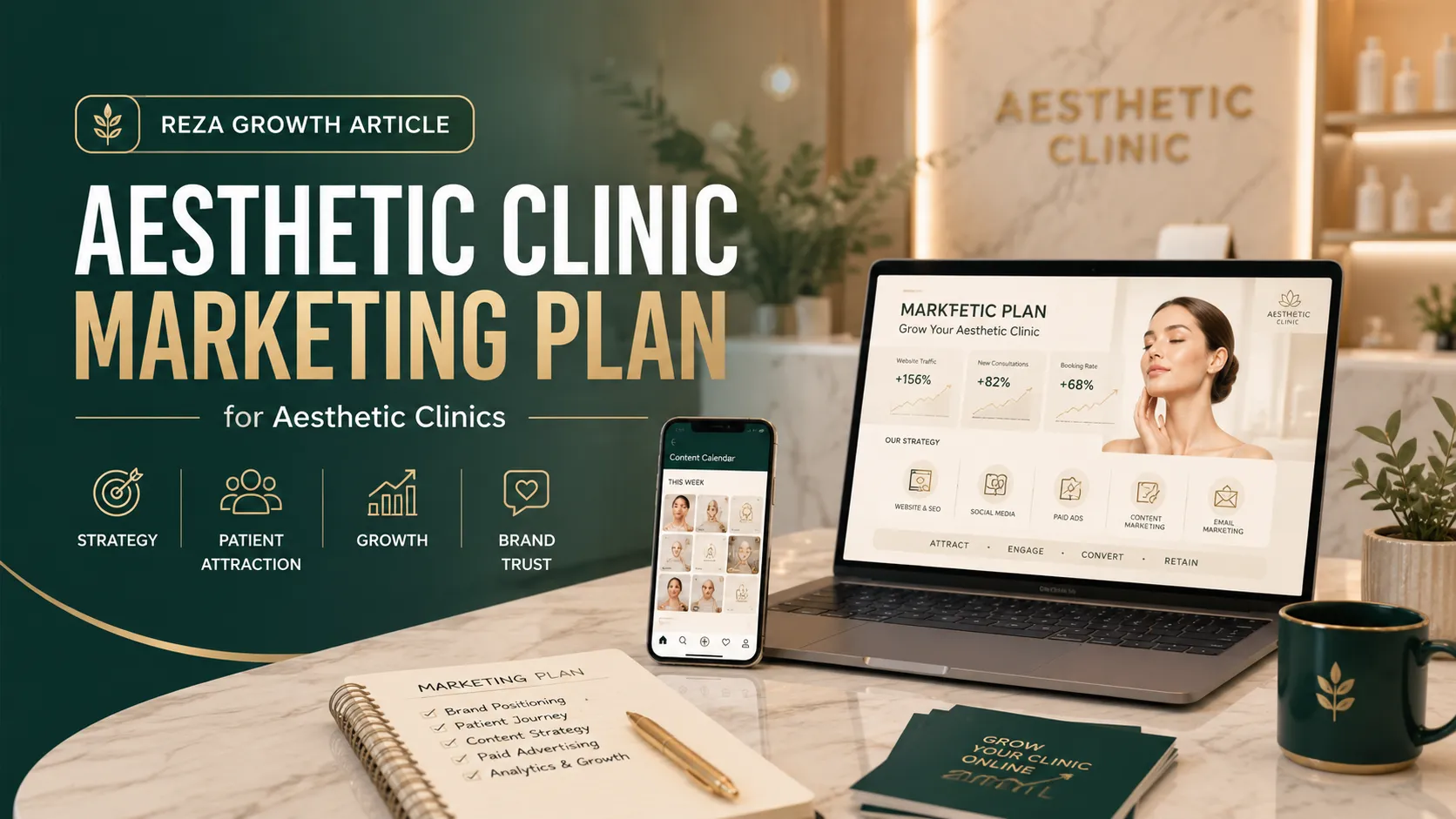
An aesthetic clinic marketing plan should do more than tell you to
post consistently, improve SEO and run ads. It should explain
what your clinic needs to achieve, which patients you want
to attract, why they should choose you, where marketing activity
should happen and what needs to happen after someone shows interest.
The most useful plan connects those decisions instead of treating
your website, social media, advertising and patient database as
separate marketing jobs.
This guide shows how to build an aesthetic clinic marketing plan around
the actual movement of a patient: from discovering your clinic to
comparing it with alternatives, making an enquiry, booking and eventually
returning for another appropriate treatment.
It is designed for clinic owners and managers who want something more
useful than a list of marketing ideas. You can use the framework to review
an existing plan or build a new one from the beginning.
What should an aesthetic clinic marketing plan actually contain?
A useful marketing plan should answer a small number of important
business questions before it turns into a calendar of posts, campaigns
and promotions.
- What does the clinic want marketing to achieve?
- Which treatments and patient groups deserve priority?
- Why should a patient choose this clinic instead of another local option?
- How will new people discover the clinic?
- What information will help them feel ready to enquire?
- How will enquiries be handled and followed up?
- How will previous patients be encouraged to return when appropriate?
- Which numbers will tell you whether the plan is improving?
This is also where a marketing plan differs from a marketing
strategy. Your strategy determines the direction and priorities.
The plan turns those decisions into specific activities, responsibilities,
channels and measurements.
Not sure what the main growth problem actually is?
If the clinic needs diagnosis before execution, our
aesthetic marketing strategy
service reviews the current marketing setup and identifies the
areas that deserve attention first.
Do not start the plan by choosing marketing channels
A common way to build a clinic marketing plan is to start with a list:
Instagram, Google, SEO, email, paid ads and perhaps influencers.
The problem is that these are distribution channels. They do not tell you
what should be communicated or what problem the channel is
supposed to solve.
Imagine two clinics in the same city offering injectables.
Clinic A has an established practitioner with strong patient results but
very little online visibility. Clinic B already receives plenty of
Instagram enquiries but the team replies inconsistently and many
prospects disappear after asking for the price.
Both clinics could say they need “more marketing”, but giving them
the same plan would make little sense. Clinic A may need visibility
and proof. Clinic B may need a stronger conversion and follow-up
process before spending more money generating enquiries.
Check what currently happens to the attention you already receive.
If enquiries are being missed, treatment pages are unclear or there
is no follow-up after the first response, generating additional
traffic may simply send more people into the same weak process.
Step 1: Define the business outcome before the marketing activity
“Grow the clinic” is too vague to guide a marketing plan. Start by
identifying the business outcome that matters during the period you are
planning for.
For example, a clinic may want to:
- increase consultations for a particular treatment;
- build demand for a newly introduced service;
- improve utilisation at a quieter location;
- increase the percentage of enquiries that become bookings;
- bring suitable previous patients back for repeat treatments;
- reduce dependence on one acquisition channel.
The objective changes the plan. A clinic trying to launch a new
body-contouring treatment needs a different mix of education, awareness
and proof than an established injectable clinic trying to improve
rebooking.
Choose one primary business outcome and a small number of supporting
outcomes for each planning period. If every treatment, every audience
and every channel is a priority, the plan does not really have a
priority.
Step 2: Decide which patients and treatments deserve priority
An aesthetic clinic rarely has only one type of patient. Someone
researching their first injectable treatment behaves differently from an
existing patient considering a maintenance appointment. A laser hair
removal patient may also have a very different decision process from
someone researching a higher-value body treatment.
Instead of describing your target patient only by age, gender or income,
connect the audience to a specific treatment need and stage of
decision-making.
| Patient situation | What they may need from marketing | Useful content or touchpoint |
|---|---|---|
| Has a concern but has not chosen a treatment | Education and treatment discovery | Educational Reels, guides and treatment comparison pages |
| Already knows the treatment | Reasons to choose your clinic | Practitioner expertise, reviews, FAQs and before-and-after evidence |
| Has asked about price or availability | A simple path towards consultation or booking | Clear response, appropriate CTA and structured follow-up |
| Previously visited the clinic | A relevant reason to return | Reminders, rebooking and personalised reactivation |
Step 3: Give patients a reason to choose your clinic
Before deciding what to publish, identify what should become more obvious
about the clinic.
If ten nearby clinics appear to offer the same treatment using similar
language, simply creating more posts may make your clinic more visible
without making it easier to choose.
Look at your local competitors and ask:
- Which treatments are they strongly associated with?
- What claims and messages appear repeatedly?
- What evidence do they show?
- Which patient questions do they answer well?
- Which questions or concerns remain poorly addressed?
- What is genuinely different about your clinic, practitioner, process or patient experience?
A clinic should not automatically position itself as “premium”
because the interior looks expensive. A stronger distinction might be
a practitioner-led consultation process, a specialist treatment
focus, a conservative treatment philosophy, advanced technology,
multi-stage aftercare or another difference the patient can actually
understand and value.
This decision becomes the foundation for the message used across your
website, social content and campaigns.
Step 4: Build the plan around five stages of patient growth
At Reza Growth, we find it more useful to organise clinic marketing
around the job each activity needs to perform rather than around the
channel where it happens.
-
Category
Clarify why the clinic or priority treatment should be considered and
what makes it easier to choose. -
Awareness
Put the clinic in front of suitable people and help them recognise
the problem, treatment or possibility. -
Consideration
Give interested patients the information and evidence they need while
they compare options. -
Conversion
Turn interest into enquiries and enquiries into confirmed bookings. -
Retention
Create appropriate reasons and reminders for existing patients to
return instead of treating every booking as the end of the journey.
This prevents one of the most common planning problems: investing almost
all marketing effort in awareness while leaving decision-making,
conversion and retention largely unplanned.
Step 5: Plan Awareness — how will the right patients discover you?
Awareness activity should introduce your clinic, treatments and relevant
patient problems to people who may not yet be ready to book.
Possible channels include social media, search, local visibility,
advertising, partnerships and other forms of discovery. The right mix
depends on the clinic rather than on which channel is currently popular.
Search-led discovery
Useful when patients already know what they are looking for and
actively search for a treatment, clinic or answer to a treatment
question.
Social-led discovery
Useful for introducing problems, treatments, practitioners and
results to people before they actively search for a provider.
If Google is an important acquisition channel, our guide on
how aesthetic clinics can get patients from Google
explains the search side in more detail. Clinics focusing on organic
search can also review our
SEO for aesthetic clinics
service.
Step 6: Plan Consideration — answer the questions patients ask before booking
Awareness gets attention. Consideration helps a patient decide whether
your clinic belongs on their shortlist.
This is where a clinic marketing plan needs more than promotional
content. Potential patients may want to understand the treatment,
suitability, practitioner, process, likely experience, aftercare,
alternatives and what makes one clinic different from another.
Useful consideration assets
- clear treatment pages;
- practitioner profiles;
- frequently asked questions;
- reviews and testimonials;
- appropriate before-and-after content;
- treatment comparisons;
- short case examples;
- educational videos explaining the treatment process.
Your website plays an especially important role here. It should give
patients somewhere useful to continue their research after discovering
the clinic on Instagram, Google or another channel.
Our guide to
aesthetic clinic website features
covers the elements that can support that decision process. If the
current website itself is the problem, see our
aesthetic clinic website design
service.
Step 7: Plan Conversion before you generate more enquiries
A marketing plan should define what happens after someone decides they
are interested.
Check every path an enquiry can take:
- website consultation or enquiry forms;
- online booking;
- phone calls;
- Instagram or social media messages;
- email;
- other approved messaging channels used by the clinic.
Then look at what happens after the first contact. Is ownership clear?
Does the team know what information to ask for? Are common objections
answered consistently? Is there another follow-up when an interested
person stops replying?
Do not automatically diagnose low bookings as a traffic problem.
If the clinic is already receiving enquiries but a large proportion
never move forward, the priority may sit in response, qualification,
follow-up or the booking process rather than in generating another
hundred visitors.
If your broader objective is patient acquisition, read our guide on
how to get more patients for an aesthetic clinic
.
Step 8: Add Retention to the marketing plan from the beginning
Many plans have detailed sections for acquiring new patients and almost
nothing for people who have already visited the clinic.
Retention does not mean sending the same promotion to the entire patient
database. A better plan asks which patients may have a legitimate reason
to hear from the clinic again and when that communication should happen.
A patient who completed a course of laser sessions should not
automatically receive the same message as a patient who previously
had an injectable treatment. Their treatment history, potential
rebooking period and relevant next step are different.
A basic retention plan can include:
- treatment-related reminders where appropriate;
- rebooking communication;
- reactivation of suitable inactive patients;
- relevant complementary treatment communication;
- loyalty or patient relationship initiatives;
- clear scripts and responsibilities for the clinic team.
Do you already have a patient database but no return system?
Our
aesthetic clinic patient retention
service focuses on follow-up, reminders, rebooking and reactivation
so previous patient relationships are not left outside the marketing plan.
Step 9: Turn the plan into a channel map
Only after the previous decisions are clear should you decide exactly
what each marketing channel needs to do.
| Channel | Possible role in the plan | Example |
|---|---|---|
| Website | Consideration + Conversion | Explain a treatment, present evidence and lead to a consultation enquiry |
| Google / SEO | Awareness + Consideration | Reach people already researching a treatment or local provider |
| Awareness + Consideration | Educate, show practitioners, answer concerns and demonstrate suitable proof | |
| Paid advertising | Awareness or Conversion | Introduce a treatment or drive suitable prospects towards a focused landing page |
| Email / patient communication | Consideration + Retention | Nurture interest or reconnect with appropriate previous patients |
This also keeps content planning more focused. Instead of telling the
social team to “post three times this week”, you can define what each
piece of content needs to accomplish.
For practical examples, see our
aesthetic clinic Instagram content ideas
.
Clinics that need ongoing planning and production can also explore
social media marketing for aesthetic clinics
.
Step 10: Set a budget by priority, not by equal distribution
A marketing budget does not need to give every channel an equal share.
It should reflect what the clinic currently needs most.
If the website cannot convert traffic effectively, it may make more sense
to improve that foundation before significantly increasing advertising.
If the clinic already has a strong website but poor search visibility,
SEO may deserve more attention. If acquisition is healthy but previous
patients rarely return, retention may deserve investment before another
awareness campaign.
The purpose of budgeting is not to make the plan look balanced.
It is to fund the activities most likely to remove the current
constraint while keeping the rest of the patient journey functional.
Step 11: Decide what you will measure at each stage
Do not judge the entire marketing plan using one number.
Different parts of the system have different jobs.
| Stage | Questions to measure | Possible indicators |
|---|---|---|
| Awareness | Are more suitable people discovering the clinic? | Relevant reach, search visibility, qualified website visits |
| Consideration | Are interested people continuing to research the clinic? | Treatment-page engagement, useful content interactions, consultation interest |
| Conversion | What happens to the interest being generated? | Enquiries, enquiry-to-booking movement, drop-off points |
| Retention | Are suitable previous patients returning? | Rebookings, successful reactivation and repeat visits |
You can still track channel metrics such as rankings, website sessions,
ad costs or content performance. The important point is to connect them
to the business outcome they are supposed to support.
A simple monthly planning example for an aesthetic clinic
Consider a clinic that wants to increase consultations for a skin
rejuvenation treatment while also improving repeat visits from existing
skin patients.
-
Week 1 — Category and foundation
Review competing clinics, clarify the treatment message, improve the
main treatment page and check the enquiry route. -
Week 2 — Awareness
Publish educational content around the problems the treatment may
address and improve relevant local/search visibility. -
Week 3 — Consideration
Publish practitioner-led explanations, FAQs, suitable evidence and
content answering the main concerns heard during consultations. -
Week 4 — Conversion and retention
Review enquiry handling, follow up suitable undecided prospects and
identify previous patients who may appropriately be due for another
conversation with the clinic.
The exact activity will differ between clinics. The important part is
that the month is connected to one commercial priority rather than being
a random collection of posts and promotions.
Common aesthetic clinic marketing plan mistakes
Weak planning
- Starting with channels instead of the business problem
- Trying to promote every treatment equally
- Copying competitor offers without a clear reason
- Measuring likes while ignoring enquiries and bookings
- Buying more traffic before reviewing conversion
- Having no plan for previous patients
Stronger planning
- Starting with one clear business priority
- Choosing priority treatments and patient groups
- Defining why the clinic should be chosen
- Giving each channel a specific job
- Reviewing the path from interest to booking
- Including retention from the beginning
Your aesthetic clinic marketing plan checklist
- Define the primary growth objective.
- Select priority treatments and patient groups.
- Review competitors and clarify your reason to be chosen.
- Check current marketing and conversion leaks.
- Plan Awareness activity.
- Plan Consideration content and evidence.
- Map every enquiry and booking route.
- Create a follow-up process.
- Add a patient retention plan.
- Assign a clear job to each marketing channel.
- Allocate budget according to priority.
- Choose a small set of useful performance indicators.
- Review results and adjust the next planning period.
Final takeaway
A strong aesthetic clinic marketing plan is not the longest document
and it does not need the largest number of channels.
It needs to make the next marketing decisions clearer:
who you are trying to reach, why they should choose you,
how they will discover the clinic, what will help them decide,
how interest becomes a booking and what happens after the first visit.
When those pieces are connected, SEO, social media, the website,
campaigns and patient communication stop functioning as isolated
activities and start working as parts of the same growth plan.
Need a clearer marketing direction for your clinic?
Reza Growth helps aesthetic clinics identify where growth is being
held back and connect the right marketing activities across
positioning, awareness, consideration, conversion and retention.
Frequently asked questions
What is an aesthetic clinic marketing plan?
An aesthetic clinic marketing plan is a practical document
that defines the clinic’s marketing objectives, priority
patients and treatments, positioning, channels, activities,
conversion process, retention activity and the measurements
used to review progress.
What is the difference between a marketing plan and a marketing strategy?
Marketing strategy determines the direction: which market,
audience, positioning and priorities make sense. The marketing
plan translates those decisions into specific activities,
channels, responsibilities, budgets and measurements.
Which marketing channels should an aesthetic clinic use?
There is no single channel mix that fits every clinic.
The choice should depend on the clinic’s priority treatments,
target patients, current visibility, existing marketing
assets, budget and the main constraint affecting growth.
Website, SEO, social media, paid advertising and patient
communication can all play different roles.
Should a clinic focus on getting more leads first?
Not automatically. First review whether the clinic is already
receiving enquiries that are being lost through unclear pages,
slow or inconsistent responses, weak follow-up or a difficult
booking route. If those problems exist, improving the
conversion process may deserve attention before increasing
lead volume.
How often should an aesthetic clinic review its marketing plan?
The main direction should remain stable long enough to be
implemented, but performance should be reviewed regularly.
Monthly reviews can identify operational problems and changes
in performance, while larger decisions about priorities,
budget and channel mix can be revisited when enough information
has accumulated to make a useful decision.