
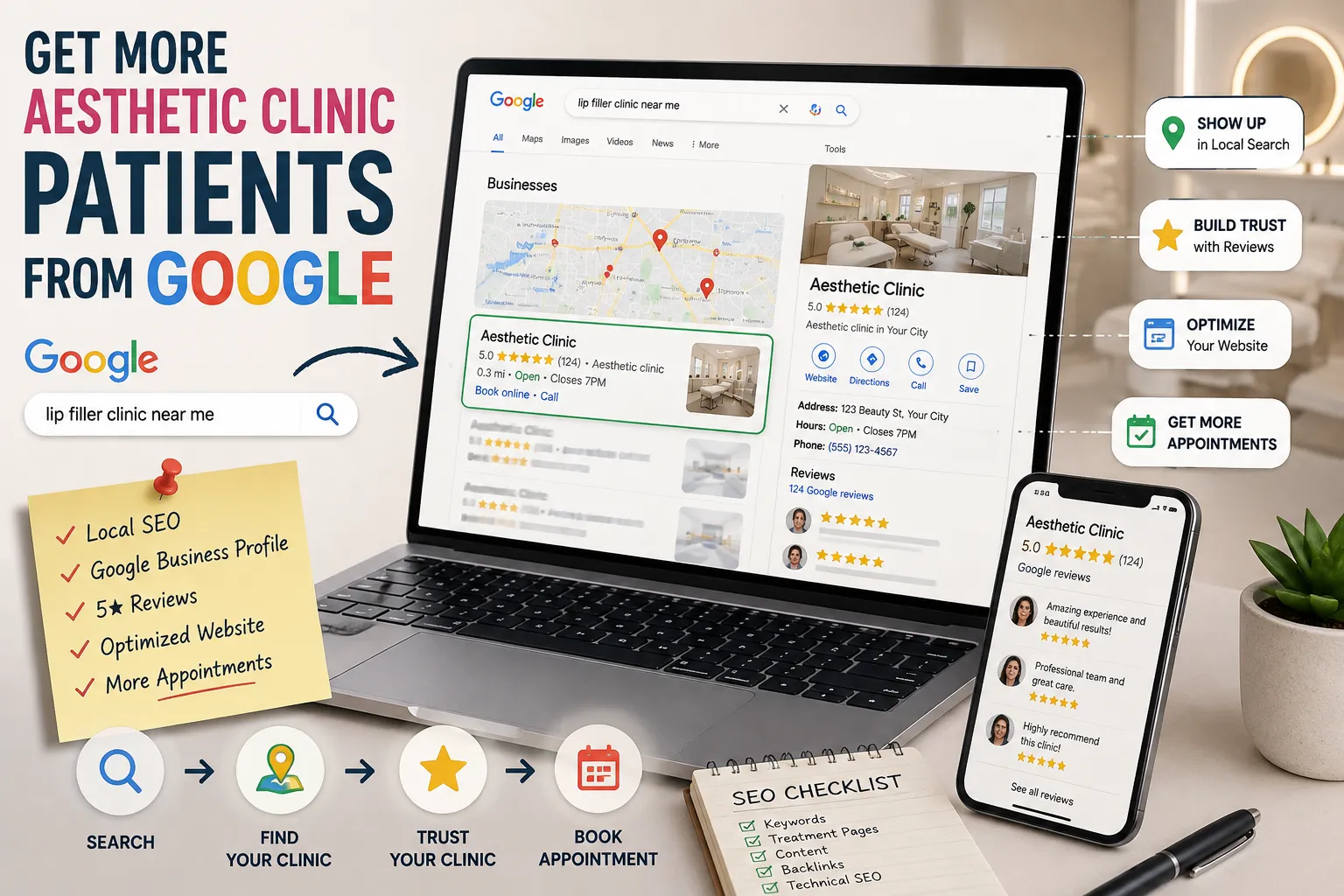
When someone searches Google for an aesthetic treatment, they are often much closer to booking than a person casually scrolling through social media. They may already know what treatment they want, have a location in mind and be comparing a small number of clinics.
That makes Google one of the most valuable patient acquisition channels for an aesthetic clinic. But appearing in search results is only the beginning. Your clinic also needs to look relevant, trustworthy and easy to contact.
This guide explains how to get aesthetic clinic patients from Google organically by connecting your website, treatment pages, Google Business Profile, reviews and enquiry process.
Understand how a patient chooses a clinic on Google
A potential patient does not usually choose a clinic after seeing one search result. They may move between Google Maps, your website, treatment pages, reviews, images and social media before making a decision.
During that process, they are trying to answer a few simple questions:
- Does this clinic offer the treatment I need?
- Is it located close enough to me?
- Does the clinic appear safe and professional?
- Can I trust the practitioner and the results?
- Is it easy to request a consultation?
Your Google visibility should therefore be treated as a complete patient journey, not just a ranking position.
Start with searches that show booking intent
Many clinics try to rank for broad phrases that receive attention but do not necessarily produce enquiries. The strongest opportunities usually come from searches that combine a treatment, concern or location.
Examples include:
- Lip filler clinic in [city]
- Skin tightening treatment near me
- Profhilo clinic in [location]
- Acne scar treatment in [city]
- Best aesthetic clinic near me
These searches reveal a clear need and often indicate that the patient is already comparing providers.
Your clinic does not need to rank for every aesthetic term. It needs to rank for the treatments and locations that are most valuable to the business.
Create a dedicated page for every important treatment
A single page listing all your treatments is rarely enough. Google and potential patients both need a clear page that focuses on one specific treatment.
A strong treatment page should explain:
- What the treatment is
- Who it may be suitable for
- Which concerns it can address
- What happens during the appointment
- Expected recovery or downtime
- Common risks and considerations
- Why patients should choose your clinic
- How to request a consultation
The page should also include the clinic’s location naturally where relevant. For example, a page about microneedling should not only explain microneedling. It should make it clear that the treatment is available at your clinic in the area you serve.
This is where professional SEO for aesthetic clinics becomes important. The aim is not to repeat keywords. The aim is to build the most useful and trustworthy result for the patient’s search.
Make your Google Business Profile useful, not merely complete
Your Google Business Profile can appear when someone searches for an aesthetic clinic, a treatment near them or your clinic’s name. Simply creating the profile is not enough.
Check that it contains:
- The correct clinic name, address and telephone number
- Accurate opening hours
- The most relevant primary and secondary categories
- A clear description of the clinic and its services
- Links to the correct website and booking page
- High-quality photographs of the clinic and team
- A complete list of important treatments
The information on your profile should match the information on your website. Different telephone numbers, address formats or opening hours can create confusion for patients and weaken trust.
Use real clinic photographs to reduce uncertainty
Aesthetic treatments require a high level of trust. Before contacting the clinic, a patient may want to see the environment, treatment rooms, practitioners and overall standard of care.
Upload clear and current photographs of:
- The clinic exterior and entrance
- Reception and waiting areas
- Treatment rooms
- Practitioners and team members
- Consultation spaces
- Relevant treatment equipment
Avoid relying entirely on stock images. A polished stock photograph may look attractive, but it does not show the patient what they will actually experience when they visit.
Build a review process instead of asking randomly
Reviews influence both trust and the way a clinic appears in local search. However, many clinics only ask for a review occasionally, usually when someone remembers.
A better process is simple:
- Identify the right moment after a positive treatment experience.
- Send the patient a direct link to the Google review form.
- Keep the request short and personal.
- Respond professionally to every genuine review.
Do not pressure patients or offer misleading incentives. The goal is to make it easy for satisfied patients to share an honest experience.
Reviews are most useful when they develop consistently over time. A clinic with regular, detailed reviews often appears more active and credible than one that collected many reviews in a short campaign and then stopped.
Your website must support the promise made on Google
Ranking well will not produce enough patients if the website feels outdated, confusing or difficult to use on a phone.
A visitor arriving from Google should immediately understand:
- Which clinic they have reached
- Where the clinic is located
- Which treatment the page is about
- Why the clinic is credible
- What they should do next
The site should have clear treatment pages, visible practitioner information, reviews or other trust signals and an obvious consultation button.
A professional aesthetic clinic website design should support both rankings and patient decisions. A beautiful website that does not answer patient questions can still lose enquiries. A well-optimised website that feels untrustworthy can have the same problem.
Do not send every Google visitor to the homepage
Someone searching for a specific treatment should usually land on the page for that treatment, not a general homepage.
For example, a person searching for skin tightening should arrive on a page focused on skin tightening, with relevant information, evidence, practitioner details and a clear route to consultation.
This creates a closer match between the search and the page. It also reduces the amount of work the visitor must do to find the information they need.
Answer the questions patients ask before booking
Treatment pages capture patients with stronger booking intent. Blog articles and guides help reach people who are still researching.
Useful topics may include:
- How long does a treatment last?
- What is the expected downtime?
- Is the treatment suitable for a specific concern?
- How does one treatment compare with another?
- What should a patient expect during consultation?
Each useful article should naturally link to the relevant treatment or service page. This helps the visitor continue their research while strengthening the structure of the website.
The important point is not to publish generic articles simply to make the blog look active. Every article should answer a real question and guide the right person towards the next useful page.
Make trust visible before asking for an enquiry
Patients may leave a clinic website even when the treatment looks suitable because they cannot find enough evidence to feel confident.
Useful trust signals include:
- Clear practitioner qualifications
- Professional memberships where applicable
- Real clinic photographs
- Patient reviews
- Transparent consultation information
- Before-and-after images used with appropriate consent
- Clear safety and aftercare information
These elements should appear close to important decision points. Do not hide all practitioner information on the About page or all reviews on a separate testimonials page.
Remove friction from the consultation process
Some clinic websites make patients work too hard to make contact. They hide the telephone number, use long forms or send every enquiry to a general contact page.
A strong enquiry path should:
- Use a clear consultation button
- Keep forms short
- Work properly on mobile devices
- Explain what happens after the form is submitted
- Give the team enough information to respond appropriately
The patient should never have to search the site to find out how to book.
Track enquiries, not just traffic
More impressions and website visits can look positive, but they do not automatically mean the clinic is growing.
Track outcomes such as:
- Consultation form submissions
- Telephone calls from Google
- Booking button clicks
- Directions requested through Google Maps
- Enquiries generated by specific treatment pages
- Enquiries that become booked consultations
This shows which treatments, pages and locations are producing genuine opportunities. It also prevents the clinic from judging SEO only by rankings.
Organic growth and Google Ads serve different purposes
Google Ads can generate visibility quickly, while organic SEO usually takes longer to build. The two channels can work together, but they should not be confused.
Google Ads
Paid traffic stops when the campaign stops.
Organic SEO
Strong organic visibility can continue producing enquiries from treatment pages, Google Maps, reviews and useful content over time.
For clinics that want more predictable long-term growth, organic visibility should be treated as a business asset rather than a one-off marketing campaign.
A practical 30-day action plan
You do not need to rebuild the entire clinic website in one week. Start with the areas most likely to affect enquiries.
- Review your Google Business Profile: correct the details, categories, services, photos and links.
- Choose one priority treatment: check whether it has a dedicated, useful page.
- Improve trust: add practitioner information, clinic photos and genuine patient reviews.
- Fix the enquiry path: make the consultation process clear and simple on mobile.
- Create a review routine: make review requests part of the patient journey.
- Track real enquiries: identify which pages and searches produce consultation requests.
Turn Google visibility into patient growth
Getting aesthetic clinic patients from Google is not about one keyword, one blog article or one Google Business Profile update.
The strongest results come from connecting the full journey:
Search visibility → relevant page → trust → enquiry → consultation.
If one part of that journey is weak, the clinic may receive traffic without enough bookings. A complete strategy looks at rankings, website structure, treatment pages, local visibility, reviews and conversion together.
Reza Growth helps aesthetic clinics identify where this journey is breaking and build a clearer system for attracting qualified patients through Google.
Request a free clinic growth review
to find out which parts of your website and Google visibility need attention first.