
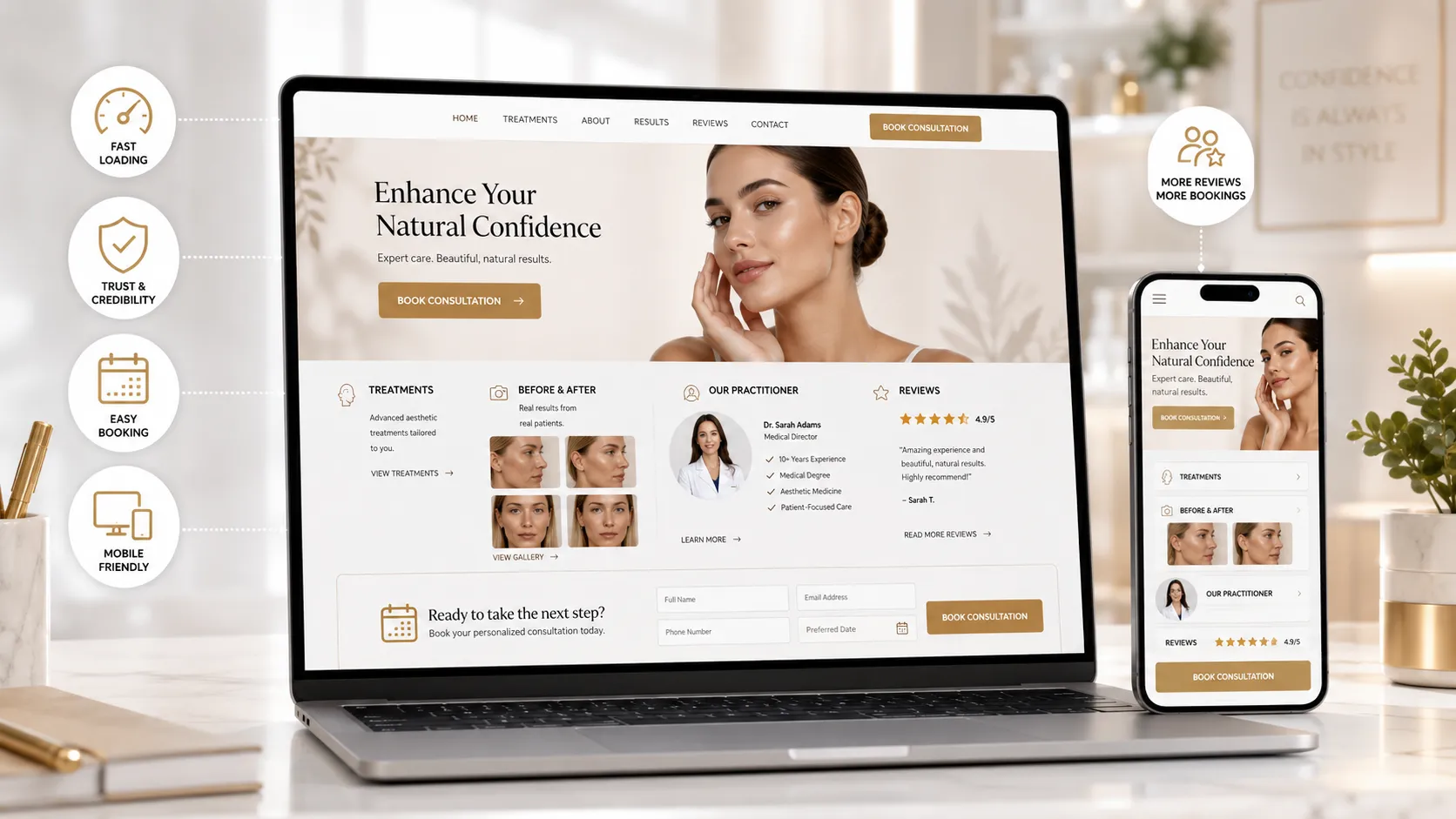
A clinic website should do more than look professional. It should help potential patients understand your treatments, trust your team and take the next step towards booking a consultation.
Many aesthetic clinic websites receive visitors but fail to turn those visitors into enquiries. The problem is often not the quality of the clinic itself. It is usually the way the website presents information, answers patient concerns and guides people towards booking.
In this guide, we will look at the most important aesthetic clinic website features and explain how each one can help improve patient trust, user experience and appointment bookings.
Why Website Features Matter for Aesthetic Clinics
Patients researching aesthetic treatments rarely book immediately after seeing a clinic name for the first time. They usually compare several clinics, read treatment information, check reviews, look at results and assess whether the practitioner feels trustworthy.
Your website plays a major role during this decision-making process. A confusing, slow or outdated website can make a professional clinic appear less reliable. On the other hand, a clear and well-structured website can answer patient questions before they even contact you.
The goal is not to add as many features as possible. Every element should have a clear purpose: helping the visitor feel informed, comfortable and ready to make an enquiry.
1. A Clear Homepage Message
When someone lands on your homepage, they should understand within a few seconds:
- What type of clinic you are
- Which treatments you offer
- Where your clinic is located
- What makes your clinic different
- What the visitor should do next
A common mistake is using vague headlines such as “Feel Like the Best Version of Yourself.” While this may sound attractive, it does not clearly explain what the clinic offers.
A stronger homepage message would be more specific:
Doctor-led aesthetic treatments in Manchester, with personalised consultations and natural-looking results.
This type of message immediately communicates the service, location and positioning of the clinic.
Your homepage should then guide visitors towards your main treatments, practitioner information, patient results and booking options.
2. Mobile-Friendly Website Design
Many potential patients will first visit your website on a mobile phone. They may discover your clinic through Google, Instagram, a recommendation or a local search.
A website that looks good on desktop but is difficult to use on mobile can quickly lose those visitors.
A mobile-friendly aesthetic clinic website should have:
- Readable text without zooming
- Buttons that are easy to tap
- A simple navigation menu
- Images that fit the screen correctly
- Booking buttons in visible positions
- Forms that are easy to complete
The mobile version should not feel like a smaller copy of the desktop website. It should be designed around the way patients actually browse and make decisions on their phones.
3. Fast Loading Speed
A slow website creates friction before the patient has even read about your clinic.
Large images, unnecessary animations, heavy plugins and poorly optimised pages can all increase loading times. This is particularly common on aesthetic websites because they often contain high-resolution treatment images and videos.
To improve speed, clinics should:
- Compress website images
- Use modern image formats
- Avoid unnecessary visual effects
- Remove unused plugins and scripts
- Use reliable hosting
- Optimise the website for mobile performance
Website speed affects more than convenience. It can influence user experience, conversion performance and organic visibility in Google.
4. Dedicated Pages for Every Main Treatment
Each important treatment should have its own detailed page. Putting every service on one general treatments page makes it harder for patients to find the information they need and harder for Google to understand the focus of each page.
A strong treatment page should explain:
- What the treatment is
- Who it may be suitable for
- Which concerns it addresses
- What happens during the appointment
- Expected downtime
- When results may become visible
- How long results may last
- Important aftercare information
- Common patient questions
- How to book a consultation
Treatment pages should educate rather than simply promote. Patients are more likely to enquire when they feel their concerns have been understood and their main questions have already been answered.
Well-structured treatment pages can also support your clinic’s organic search strategy. You can learn more about this in our guide to SEO for aesthetic clinics.
5. A Professional Before-and-After Gallery
Before-and-after images are among the most persuasive elements on an aesthetic clinic website because they show the type of results the clinic has achieved.
However, the quality and presentation of these images matter.
A professional gallery should use:
- Consistent lighting where possible
- Similar angles in both images
- Clear and high-quality photography
- Real clinic results with appropriate consent
- Simple labels identifying the treatment
- Realistic examples rather than only extreme transformations
Avoid filling the gallery with stock images or heavily edited results. Patients are looking for evidence they can trust.
It is also useful to place relevant results directly on individual treatment pages instead of keeping every image in one separate gallery.
6. Clear Practitioner Credentials
Aesthetic treatments involve a high level of personal trust. Patients want to know who will perform the treatment and whether that person has the right experience.
Your practitioner pages should include:
- Professional qualifications
- Relevant training
- Years of experience
- Areas of special interest
- Professional registrations where applicable
- A natural and professional photograph
- A short explanation of the practitioner’s approach
This section should not read like a formal CV. It should help the patient understand the person behind the qualifications.
For example, explaining that a practitioner focuses on subtle, natural-looking outcomes may be more meaningful to a potential patient than listing qualifications without any context.
7. Patient Reviews and Trust Signals
A clinic can describe itself as professional and trustworthy, but patients will often place more confidence in the experiences of other patients.
Useful trust signals include:
- Verified patient reviews
- Google review ratings
- Video testimonials
- Professional memberships
- Relevant registrations
- Awards that genuinely matter
- Clinic location and contact information
Reviews should be placed throughout the website, particularly near treatment information and booking calls to action.
Avoid displaying only vague testimonials such as “Amazing service.” Detailed reviews that mention the consultation, practitioner, treatment experience or results are far more useful.
8. Clear Calls to Action
A call to action tells the visitor what to do next. Without one, a patient may read the page, feel interested and still leave without contacting the clinic.
Common calls to action for aesthetic clinics include:
- Book a Consultation
- Request an Appointment
- Ask About This Treatment
- Speak to Our Clinic Team
- Check Treatment Availability
The wording should match the stage of the patient journey. Someone researching a treatment may not be ready to “Book Now,” but they may feel comfortable requesting a consultation or asking a question.
Calls to action should appear:
- Near the top of important pages
- After key treatment information
- Near reviews or results
- At the end of each treatment page
- Inside the mobile navigation or a visible mobile button
The goal is not to place a button after every paragraph. The goal is to make the next step clear whenever the patient is ready.
9. A Simple Booking and Enquiry Process
The more difficult it is to contact your clinic, the more likely a potential patient is to leave.
Long forms often create unnecessary friction. For an initial enquiry, you usually do not need to collect every detail about the patient.
A simple enquiry form may only require:
- Name
- Email address or phone number
- Treatment of interest
- A short message
Additional information can be collected later, once the clinic team has responded.
If you use online booking software, make sure the process works properly on mobile and does not force the visitor through too many screens.
You should also explain what happens after the form is submitted. A short confirmation such as “Our clinic team will contact you within one working day” reduces uncertainty and gives the patient a clear expectation.
10. Frequently Asked Questions
Patients often have concerns they may not feel ready to ask directly. A useful FAQ section can remove some of that hesitation.
Treatment-specific questions may include:
- Does the treatment hurt?
- How much downtime should I expect?
- When will I see results?
- How long do the results last?
- How many sessions might I need?
- Can I return to work afterwards?
- What happens during the consultation?
Answers should be honest and informative. Avoid promising guaranteed outcomes or making every treatment sound completely risk-free.
A strong FAQ section supports both patient trust and search visibility because it helps the page address the real questions people ask before booking.
11. Transparent Treatment Information
Patients should not need to search through several pages to find basic information.
Where appropriate, treatment pages should include:
- Starting prices or price ranges
- Approximate appointment duration
- Expected downtime
- Typical number of sessions
- Consultation requirements
- Important suitability information
Some clinics avoid displaying any prices because they want every patient to make an enquiry first. However, complete price secrecy can discourage visitors who simply want to understand whether the treatment is within their budget.
When a fixed price is not possible, a clear starting price or range can provide useful guidance while still explaining that the final cost depends on the consultation.
12. Clear Contact and Location Information
Local patients need to know where the clinic is and how easy it is to reach.
Your website should clearly display:
- Full clinic address
- Telephone number
- Email or enquiry option
- Opening hours
- Map or directions
- Nearby parking or transport information
This information should not be hidden only on the contact page. The phone number and booking option should also be easy to find from other important pages.
Consistent contact and location information can also help Google understand the local relevance of your clinic.
13. Secure Forms and Patient Privacy
Patients may share personal information when contacting an aesthetic clinic. Your website should make it clear that their information is handled responsibly.
Important website elements include:
- A valid security certificate
- Secure enquiry forms
- A clear privacy policy
- Consent checkboxes where required
- No unnecessary collection of sensitive information
The initial website enquiry form should not be used to collect detailed medical information unless the system has been designed and secured for that purpose.
14. Conversion Tracking and Website Analytics
A clinic website cannot be improved properly without understanding how visitors use it.
At a minimum, clinics should track:
- Consultation form submissions
- Online booking completions
- Telephone link clicks
- Email link clicks
- WhatsApp or messaging clicks
- Visits to important treatment pages
Traffic alone does not show whether a website is performing well. A clinic may receive hundreds of visitors while generating very few genuine enquiries.
Tracking allows you to identify which pages attract patients, where people leave and which treatments generate the most interest.
What Makes an Aesthetic Clinic Website High-Converting?
A high-converting clinic website is not necessarily the website with the most animations, the longest pages or the most expensive visual design.
It is a website that makes the patient’s decision easier.
It should answer four important questions:
- Does this clinic offer the treatment I need?
- Can I trust the practitioner and the quality of care?
- Do the results and approach match what I am looking for?
- Is it easy to ask a question or book a consultation?
When these answers are clear, patients are more likely to take action.
Common Aesthetic Clinic Website Mistakes
Even visually attractive clinic websites can lose potential bookings because of avoidable mistakes.
Some of the most common issues include:
- Generic homepage messaging
- No clear booking button
- Thin treatment pages
- Slow loading on mobile
- Poor-quality before-and-after images
- Missing practitioner information
- Long and complicated enquiry forms
- No reviews near important decisions
- Outdated clinic information
- No conversion tracking
These problems rarely require adding more decorative elements. In many cases, the website needs a clearer structure, stronger content and a simpler patient journey.
Should You Redesign Your Aesthetic Clinic Website?
A full redesign is not always necessary. Some websites can improve significantly through better treatment pages, clearer calls to action, improved mobile usability and a simpler booking process.
A redesign may be worth considering when:
- The website looks outdated compared with the clinic
- It performs poorly on mobile
- Treatment information is difficult to find
- The website receives traffic but very few enquiries
- The booking process is confusing
- The current design cannot support your SEO strategy
- Updating content is difficult
Our aesthetic clinic website design service focuses on more than appearance. We build websites around patient trust, treatment discovery and enquiry generation.
Final Thoughts
The best aesthetic clinic website features are the ones that reduce uncertainty and help patients move confidently towards a consultation.
Clear treatment pages, practitioner credentials, real patient results, useful reviews, mobile-friendly design and a simple booking process all contribute to a stronger patient experience.
Your website does not need to pressure every visitor into booking immediately. It needs to provide the right information, build trust and make the next step feel easy.
If your clinic website looks professional but does not generate enough enquiries, the issue may be the structure and patient journey rather than the amount of traffic.
Discuss your clinic website with Reza Growth
and find out which improvements could help turn more visitors into patient enquiries.