
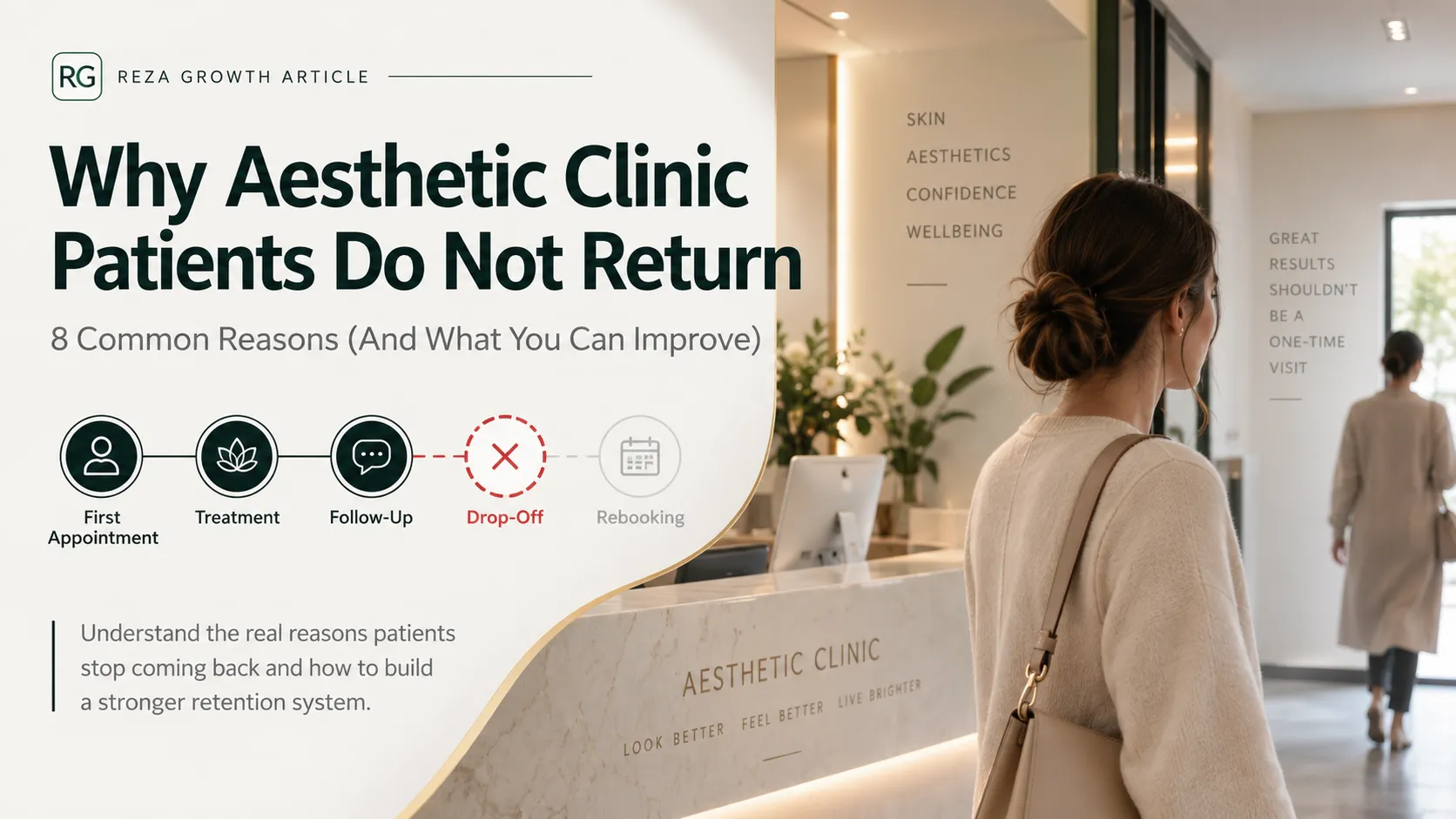
Getting a patient through the door once does not automatically make them a returning patient.
An aesthetic clinic can deliver a good treatment, attract a steady flow of new enquiries and still
find that too many patients quietly disappear after their first or second visit.
If you are trying to understand why aesthetic clinic patients do not return,
the answer is rarely one isolated problem. In many clinics, retention is lost through a series of
small gaps between the treatment, aftercare, follow-up, rebooking and future communication.
The important question is therefore not simply, “Why did this patient leave?” It is:
where in the patient journey did the clinic stop giving them a clear reason or opportunity to come back?
Patient retention is not just sending a reminder message. It is the combined effect of the
patient experience, clinical communication, follow-up, rebooking process and the way the clinic
stays relevant after the appointment.
Why Do Aesthetic Clinic Patients Stop Coming Back?
Patients can stop returning for obvious reasons, such as dissatisfaction with an experience, but
many retention losses are less visible. A patient may have been perfectly happy and still fail to
rebook because nobody explained what should happen next.
They may intend to return but forget. They may receive no communication for several months.
They may not understand when another appointment would be appropriate. Or they may simply feel
that the clinic is more focused on attracting new patients than maintaining relationships with
existing ones.
For a clinic owner or manager, this distinction matters. If you treat every lost patient as a
marketing problem, you may spend more money acquiring new patients while the real problem sits
inside the retention journey.
1. The Patient Experience Ends After the Treatment
One common retention problem is treating the appointment as the end of the patient relationship.
The patient arrives, receives the treatment, pays and leaves. Unless there is a clinical reason for
follow-up, communication may stop almost immediately.
From the clinic’s point of view, the appointment has been completed successfully. From the patient’s
point of view, however, the relationship may still be developing.
A structured post-treatment experience can help maintain that relationship. Depending on the
treatment and the clinic’s clinical protocols, this may include appropriate aftercare information,
a check-in, guidance on what happens next or a clear route for contacting the clinic if the patient
has a question.
Two patients receive the same treatment at two clinics. The first hears nothing after leaving.
The second receives appropriate aftercare information and knows exactly what the next stage of
their treatment journey looks like. Even if both treatments went well, the second clinic has
created a clearer path towards an ongoing relationship.
2. There Is No Clear Rebooking Process
Many aesthetic clinics rely on the patient to remember when they should book again. That creates an
unnecessary retention gap.
If a treatment commonly involves a future appointment, review or maintenance cycle, the clinic
should have a clear process for discussing the next appropriate step. This does not mean applying
the same schedule to every patient. Clinical recommendations must remain individual and appropriate.
The commercial problem appears when the clinic has no consistent process at all. One receptionist
may discuss rebooking, another may forget, and another may simply assume that the patient will
contact the clinic later.
A stronger system defines when rebooking should be discussed, who is responsible for doing it and
how the next step is recorded.
3. Follow-Up Is Inconsistent or Too Generic
Follow-up can support retention, but only when it has a clear purpose. Sending occasional generic
messages to an entire patient database is not the same as having a retention system.
For example, a patient who recently completed a treatment may need a different type of communication
from someone who has not visited the clinic for nine months. A patient interested in injectables may
have a completely different treatment journey from someone visiting for laser or skin treatments.
When every patient receives the same message at the same time, communication can quickly become
irrelevant.
A better approach is to connect follow-up with where the patient currently sits in their journey:
recently treated, due for a possible return, inactive or potentially suitable for another relevant
service.
4. Patients Do Not Know When They Should Return
Sometimes a patient has not actively decided to leave the clinic. They simply do not know when there
is a reason to return.
This can happen when future treatment planning is unclear or when the clinic assumes the patient
already understands maintenance intervals, review appointments or other relevant next steps.
For clinic teams, much of this information feels obvious because they deal with treatments every day.
For the patient, it may be completely new.
Review the end of your patient appointments. Does the patient leave knowing what happens next,
or are you expecting them to work that out later?
5. Existing Patients Feel Less Valued Than New Patients
A clinic can unintentionally spend far more energy communicating with potential new patients than
with people who have already trusted the clinic.
New patient campaigns receive offers, social content, enquiry follow-up and booking attention.
Meanwhile, existing patients may hear very little after their appointment.
This imbalance can become especially visible when promotional activity is heavily focused on new
patient acquisition. Existing patients do not necessarily need constant discounts or special offers,
but they should not feel forgotten.
Retention communication can instead focus on relevance: appropriate reminders, useful clinic
updates, treatment education, rebooking opportunities and communication that reflects the patient’s
existing relationship with the clinic.
6. The Clinic Does Not Stay Top of Mind
A satisfied patient can still become an inactive patient.
People are busy. They change routines, postpone appointments and become distracted by other
priorities. Competitors are also continuously appearing in their Google searches and social media
feeds.
If several months pass without relevant communication from the clinic, returning may gradually stop
feeling like the obvious next step.
This is why retention should include planned communication rather than depending entirely on the
patient remembering the clinic independently.
The goal is not to message patients constantly. It is to remain appropriately present so that when
the patient is ready to consider another treatment, the existing clinic relationship has not gone
cold.
7. The Treatment Journey Feels Disconnected
Another reason aesthetic clinic patients do not return is that different parts of the experience do
not connect.
Marketing may attract the patient with one message. The consultation may create a different
expectation. Reception may handle the booking in another way. After the treatment, nobody owns the
next stage.
Each individual interaction may appear acceptable, but the overall patient journey feels fragmented.
A stronger retention process connects the stages together:
- the original enquiry;
- consultation and treatment;
- appropriate aftercare;
- follow-up;
- future rebooking opportunities;
- reactivation if the patient becomes inactive.
This is also why patient growth should not be measured only by the first booking.
The first appointment is one stage of the commercial relationship, not automatically the end of it.
8. The Clinic Is Not Tracking Why Patients Disappear
If a clinic does not monitor retention, it can be difficult to distinguish a patient acquisition
problem from a patient retention problem.
Imagine that new patient bookings are stable, but a large proportion of previous patients are not
returning. The clinic may respond by increasing advertising or producing more content. That can
generate more first appointments, while the underlying retention leak remains unchanged.
Instead, clinic owners should periodically review what happens to existing patients after their
appointments.
How to Identify Where Your Clinic Is Losing Returning Patients
You do not need to begin with a complicated retention system. Start by making the patient journey
visible.
Review Rebooking Behaviour
Look at patients for whom another appointment could reasonably have been expected. How many booked
again? How many were given a clear next step? How many left without any future action recorded?
The objective is not to force every patient into another booking. It is to understand whether the
clinic consistently creates an appropriate opportunity for a continuing relationship.
Segment Inactive Patients
A database of previous patients becomes much more useful when it is segmented.
Instead of treating everyone who has not returned as one group, consider factors such as previous
treatment, time since the last visit and where they stopped in the patient journey.
This makes it easier to distinguish between patients who may simply be between treatment cycles and
those whose relationship with the clinic has genuinely gone inactive.
Audit Your Follow-Up Touchpoints
Map the communication a patient receives after an appointment. Ask:
- Is there an appropriate post-treatment follow-up?
- Does the patient understand the next step?
- Is a future booking discussed when appropriate?
- Is the outcome recorded somewhere the team can access?
- Does anything happen if the patient becomes inactive?
This exercise often reveals that the problem is not a complete absence of follow-up. It is
inconsistency between team members, treatments or patient groups.
Look for Patterns by Treatment
A clinic-wide retention number can hide useful information. Different treatments naturally create
different patient journeys, so it can be more useful to identify patterns within relevant treatment
categories.
For example, one part of the clinic may have a clear rebooking journey while another relies almost
entirely on patients contacting the clinic themselves.
A Simple Retention Leak Check
When reviewing an inactive patient, work backwards through the journey:
- Did they have a positive and organised clinic experience?
- Did they receive the appropriate post-treatment communication?
- Did they understand what should happen next?
- Was a future appointment discussed when relevant?
- Did the clinic stay appropriately in contact?
- Was there any reactivation process once they became inactive?
The first broken step gives you a better place to investigate than simply assuming the clinic
needs more new patients.
Retention Is a System, Not a Reminder Message
It is tempting to reduce patient retention to reminders, loyalty programmes or occasional
reactivation campaigns. Those can all play a role, but none of them fixes a disconnected patient
journey by itself.
A stronger approach connects the full sequence: the patient experience, appropriate follow-up,
rebooking, ongoing communication and reactivation.
That means the clinic needs clear responsibilities as well as messages. Someone must know when a
patient should enter a follow-up process, where that information is recorded and what happens if the
patient does not return.
For growing aesthetic clinics, this matters because continually replacing inactive patients with new
ones can make growth unnecessarily dependent on acquisition.
Build a More Structured Patient Retention System
Reza Growth’s Patient Retention System helps aesthetic clinics review the journey after the first
appointment and build more structured processes around rebooking, reminders, reactivation and
communication with previous patients.
Frequently Asked Questions
Why do satisfied aesthetic clinic patients not return?
A patient can be satisfied and still fail to return because they were not given a clear
next step, forgot to rebook, received no relevant follow-up or simply lost contact with
the clinic over time.
How can an aesthetic clinic improve repeat bookings?
Start by reviewing when rebooking is discussed, how future steps are communicated and
whether the team consistently records and follows the patient journey after each
appointment.
Should aesthetic clinics follow up with every patient?
Follow-up should be appropriate to the treatment, patient situation and clinic’s clinical
protocols. The important point is to have a consistent process rather than relying on
individual staff members to remember.
What is the difference between rebooking and patient reactivation?
Rebooking usually concerns arranging the patient’s next relevant appointment as part of
an active relationship. Reactivation focuses on patients whose relationship with the
clinic has already become inactive.
Do aesthetic clinics need a CRM for patient retention?
A CRM can make tracking and segmentation easier, but software alone does not create a
retention strategy. The clinic first needs a clear process for what should happen at each
stage of the patient journey.
Find the Gaps in Your Patient Growth System
If your clinic is attracting patients but too many disappear after their first appointments,
the issue may be happening further down the patient journey. Reza Growth can review where growth
may be getting lost and help you identify the next priorities.