
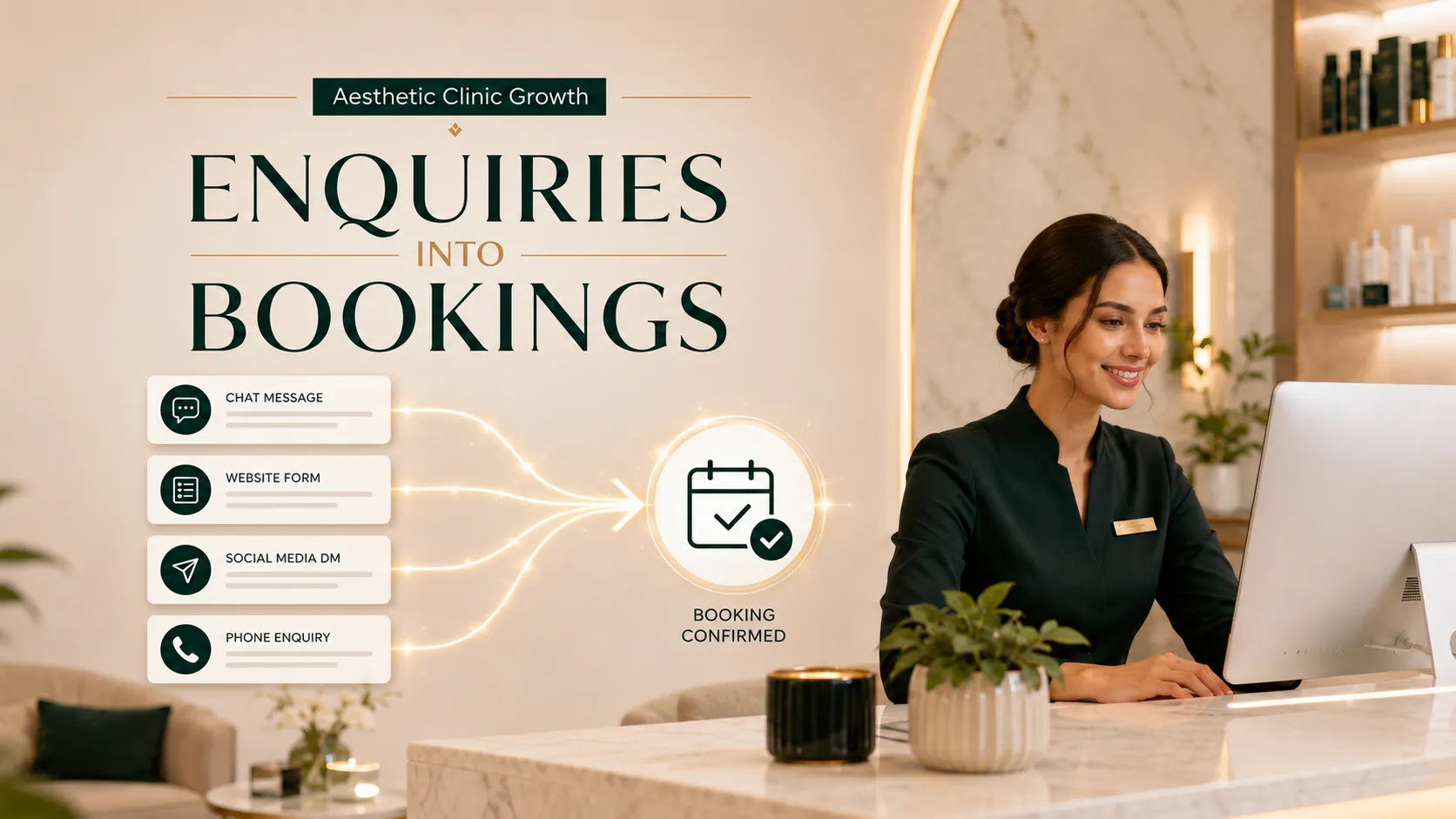
Getting more enquiries does not automatically mean getting more patients.
An aesthetic clinic can be generating enquiries through Google, Instagram,
referrals or paid campaigns and still see too many potential patients
disappear before they book. When that happens, increasing advertising spend
may simply send more people into the same leaking process.
Turning aesthetic clinic enquiries into bookings starts with looking at
what happens after someone makes contact.
How quickly do they receive a useful response? Do they know what to do next?
Are their concerns being addressed? Does someone follow up if they stop
replying? And can the clinic see where potential patients are dropping out?
The goal is not to pressure every enquiry into booking. It is to create a
clearer, more consistent journey for suitable potential patients who already
have an interest in the clinic.
Why Aesthetic Clinic Enquiries Do Not Always Become Bookings
An enquiry is a signal of interest, not a completed decision.
Someone asking about Botox pricing, laser treatment availability or a
consultation may still be comparing clinics, checking whether they trust the
practitioner, thinking about cost or trying to understand whether the
treatment is suitable for them.
That means there is usually a gap between
generating an enquiry and
converting that enquiry into a booking.
Problems can appear at several points:
- The clinic responds too slowly.
- The answer does not address what the patient actually wants to know.
- There is no obvious next step.
- Booking feels unnecessarily complicated.
- An enquiry receives one reply but no follow-up.
- Every enquiry is handled in exactly the same way.
- Nobody measures where enquiries are being lost.
Before trying to generate more leads, it is worth finding out whether the
clinic is already losing opportunities it has paid or worked to create.
1. Respond While Patient Intent Is Still High
The moment someone contacts an aesthetic clinic is usually one of the
strongest signals of intent in the patient journey.
They have moved beyond simply viewing content or browsing a treatment page.
They have decided to ask a question, request information or explore a
possible appointment.
If the response takes too long, that momentum can disappear. The potential
patient may contact another clinic, become distracted or simply lose
confidence in the process.
This does not mean the team needs to be available every minute of the day.
It means enquiries should have a clear ownership and response process.
The clinic should know:
- Which channels generate enquiries.
- Who is responsible for each channel.
- When those channels are monitored.
- What happens when an enquiry arrives outside normal working hours.
- How unanswered enquiries are identified later.
A clinic receiving enquiries through Instagram, WhatsApp, website forms,
phone calls and email can easily lose opportunities if each channel is
treated separately.
The first improvement is often not a better sales message. It is simply
making sure no enquiry disappears unnoticed.
2. Understand What the Patient Is Really Asking
Many aesthetic enquiries appear simple on the surface.
- “How much is it?”
- “Do you offer this treatment?”
- “When is the next appointment?”
But answering only the literal question can end the conversation too early.
A price enquiry, for example, may also involve uncertainty about which
treatment is appropriate, what is included, who performs the treatment or
whether a consultation is required first.
The clinic does not need to turn every answer into a long sales
conversation. The objective is to understand enough context to help the
potential patient move forward.
For example, the team can consider:
- What prompted the person to enquire.
- What they are trying to achieve.
- Whether they are still comparing options.
- What information they need before feeling comfortable taking the next step.
Medical suitability should always be handled appropriately by qualified
professionals. The marketing or reception process should not attempt to
diagnose patients.
But the communication around the treatment can still reduce uncertainty.
Patients are more likely to continue a conversation when they feel their
actual question has been understood rather than simply receiving a generic
response.
3. Give Every Enquiry a Clear Next Step
One of the easiest ways to lose an enquiry is to answer the question without
explaining what happens next.
Imagine a potential patient asks about treatment availability and receives:
“Yes, we offer it.”
The question has technically been answered, but the conversation now depends
entirely on the patient taking another initiative.
A stronger enquiry process makes the next appropriate action obvious.
Depending on the clinic and treatment, that could be:
- Arranging a consultation.
- Selecting an appointment time.
- Completing an enquiry form.
- Speaking with an appropriate member of the team.
- Receiving further information before deciding.
The important part is clarity. A potential patient should not have to work
out how to progress through the clinic.
This is particularly important when enquiries are coming from marketing
campaigns. The marketing activity may successfully create interest, but the
enquiry process still needs to carry that interest toward the next stage.
This is why patient acquisition should be viewed as a connected journey
rather than separate marketing activities. Our guide to
getting more patients for an aesthetic clinic
looks at that wider growth system, while this article focuses specifically
on what happens once the enquiry already exists.
4. Reduce Friction in the Booking Process
Sometimes a potential patient wants to move forward but the clinic makes the
process harder than necessary.
Friction can appear in small ways:
- Long forms asking for unnecessary information.
- Unclear consultation options.
- Repeated requests for information the patient already provided.
- Switching between several communication channels.
- Confusing booking pages.
- Unclear availability.
- No obvious booking or consultation CTA.
Each additional obstacle gives the patient another opportunity to stop.
This is especially important on mobile. Someone who discovers the clinic
through Instagram or Google may expect to enquire and continue the process
from their phone.
A clinic website should therefore do more than look professional. It should
make the patient journey easy to understand.
If patients regularly reach the website but struggle to take the next step,
the issue may involve the website as much as the reception process. A stronger
aesthetic clinic website design
should support clear treatment discovery, trust and enquiry pathways rather
than adding unnecessary friction.
The aim is not to remove every step. Some treatments naturally require
consultation, screening or additional information. The aim is to remove
steps that do not help the patient or the clinic make a better decision.
5. Follow Up Without Making the Patient Feel Pressured
Not every unanswered enquiry is a rejection.
People become busy. They compare providers. They may need more time to think
about the treatment, check their schedule or discuss the decision with
someone else.
If the clinic treats every unanswered message as a lost lead, potentially
valuable enquiries can disappear unnecessarily.
A structured follow-up process creates another opportunity to continue the
conversation.
The important distinction is between useful follow-up and
pressure. Good follow-up should make it easier for the potential patient to
continue where they left off. It should not repeatedly chase someone who has
clearly declined.
The clinic needs a defined approach to questions such as:
- Which enquiries should be followed up.
- Who is responsible.
- How the team knows whether follow-up happened.
- When an enquiry should be considered inactive.
- What information should be recorded.
This becomes increasingly important as enquiry volume grows. Relying on
individual team members to remember every conversation may work when enquiry
numbers are low, but it becomes unreliable as the clinic becomes busier.
The solution is a system, not simply telling reception staff to “follow up
more.”
6. Handle Different Enquiries Differently
Not every person contacting the clinic is at the same stage of the decision
process.
One person may be ready to book and only needs an available appointment.
Another may have only recently started researching the treatment. A third may
be comparing several clinics and looking for reassurance about the
practitioner or treatment process.
Giving all three people the same response can weaken conversion.
A useful distinction is between enquiries with
high booking intent and those still requiring more
consideration.
High-intent enquiries may need a quick and simple route to the next
available step. Earlier-stage enquiries may need clearer information,
reassurance or an appropriate consultation pathway before booking.
Patients normally move through several stages before booking: discovering
the clinic, considering whether they trust it, evaluating treatments and
finally deciding whether to take action.
The enquiry team needs enough context to recognise these differences. That
does not require complicated psychological profiling. It simply means
listening to what the potential patient is asking and responding to the
stage they appear to be in.
7. Track Where Enquiries Are Being Lost
A clinic cannot improve enquiry conversion reliably if it only measures the
number of leads generated.
Suppose a clinic receives more enquiries this month but bookings barely
change. That information alone does not explain the problem.
A more useful view is:
Enquiries → Responses → Consultations → Bookings
Depending on the clinic’s process, additional stages may also be useful. The
objective is to identify where the largest drop occurs.
For example:
-
Plenty of enquiries but few conversations may indicate a response
problem. -
Plenty of conversations but few consultations may indicate unclear next
steps or insufficient confidence. -
Plenty of consultations but fewer bookings may indicate a different
issue that needs separate investigation.
The clinic should also look at enquiry sources separately where practical.
An Instagram enquiry and a high-intent Google enquiry may behave very
differently. Combining everything into one headline number can hide useful
patterns.
This is also why enquiry-to-booking performance should be considered
alongside the wider
aesthetic marketing strategy
.
The goal is not simply to increase one metric. It is to understand where
growth is being constrained across the patient journey.
Before Spending More on Leads, Fix the Leaks You Already Have
When bookings are below target, the immediate reaction is often to generate
more leads.
More advertising. More content. More traffic. More campaigns.
Sometimes that is exactly what the clinic needs. But if the existing enquiry
process is leaking potential patients, more leads can simply create more
lost opportunities.
A better question is:
What happens to the enquiries we already receive?
Review the journey from first contact to booking. Look at response ownership,
patient questions, next steps, booking friction, follow-up, different levels
of intent and the numbers between each stage.
Then identify where improvement is most likely to make a meaningful
difference.
This reflects a broader principle behind Reza Growth’s approach to patient
growth: marketing should work as a connected system.
Generating attention is useful. Creating enquiries is useful. But growth is
incomplete if interested potential patients repeatedly disappear before they
reach the clinic.
Frequently Asked Questions
What is a good enquiry-to-booking conversion rate for an aesthetic clinic?
There is no single conversion rate that is appropriate for every
aesthetic clinic. Results can vary by treatment, enquiry source,
price point, location, clinic positioning and how the enquiry is
defined. The most useful starting point is to establish your own
baseline and compare performance by source and stage over time.
Why do aesthetic clinic leads stop responding?
Potential patients can stop responding for many reasons, including
delayed replies, unanswered concerns, unclear next steps, comparison
with other clinics or simply needing more time. Reviewing the
conversation and follow-up process is more useful than assuming every
silent enquiry was low quality.
Should an aesthetic clinic follow up with every enquiry?
Not necessarily. Follow-up should depend on the context of the
enquiry and whether the person has shown relevant interest. Someone
who has clearly declined should not be repeatedly contacted, while a
suitable patient who simply stopped replying may benefit from an
appropriate follow-up.
Is getting more leads the best way to increase aesthetic clinic bookings?
Not always. If the clinic already receives a reasonable number of
enquiries but loses many before consultation or booking, improving
conversion may deserve attention before increasing lead volume.
Who should be responsible for enquiry conversion in an aesthetic clinic?
Responsibility should be clearly defined within the clinic.
Depending on the business, this may involve reception staff, patient
coordinators or another appropriate team member. What matters is
that enquiries have clear ownership and that the process is
consistently followed.