
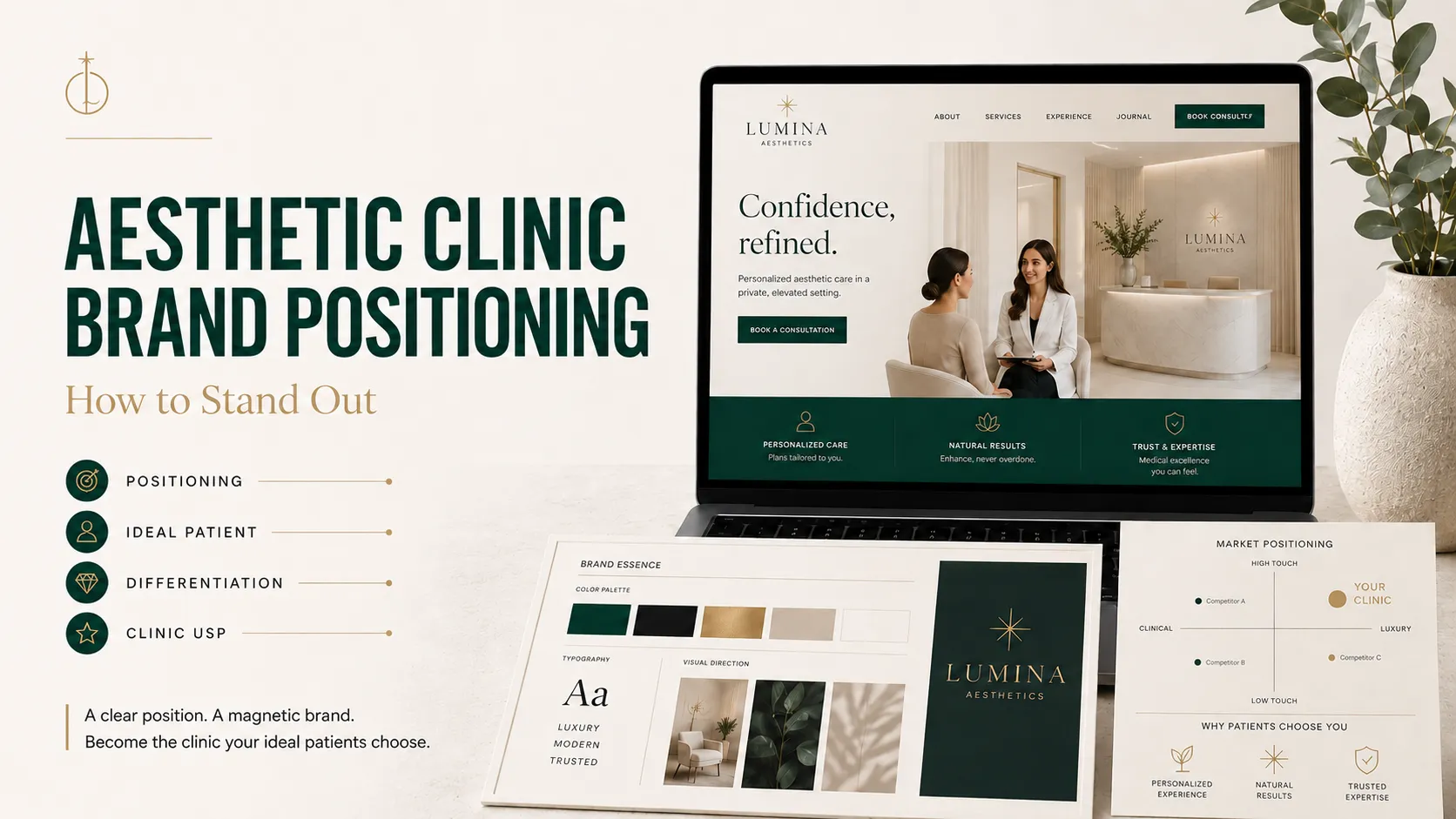
Aesthetic clinic brand positioning is not simply about how your clinic looks. It is about the position your clinic occupies in a patient’s mind when they compare you with other credible options.
If several clinics in the same area offer similar treatments, use similar language and make similar promises, patients have very little reason to prefer one over another. That can make marketing harder, increase price sensitivity and leave your team relying on promotions or individual practitioners to create differentiation.
Strong positioning gives the clinic a clearer answer to a simple question: why should the right patient choose us?
The answer should influence more than your homepage headline. It should shape the patients you target, the services you emphasise, the messages you repeat and the experience patients receive throughout their journey with the clinic.
What Is Aesthetic Clinic Brand Positioning?
Brand positioning defines what you want your aesthetic clinic to be known for, who you want to be known by and why that position should matter to those patients.
It sits underneath the visible parts of your brand.
Your logo, colour palette, photography and social media aesthetic can help communicate a position, but they do not create one by themselves.
For example, two clinics may both have elegant websites, experienced practitioners and premium-looking Instagram feeds. If both describe themselves as providing “personalised treatments and natural results”, the patient may still struggle to understand the meaningful difference between them.
Positioning provides that difference.
A clinic might become known for a particular patient group, treatment category, practitioner-led approach, patient experience, clinical philosophy or combination of factors that competitors cannot easily claim in the same way.
Brand Positioning and Branding Are Not the Same Thing
Branding is how the clinic expresses itself. Positioning determines what that expression needs to communicate.
Brand positioning
Defines who the clinic is for, what it wants to be known for, how it differs from alternatives and why that difference matters to patients.
Brand identity
Translates the position into visible and verbal elements such as design, photography, tone of voice, messaging and presentation.
This distinction matters because clinics sometimes try to solve a positioning problem with a visual redesign.
A new logo can improve presentation, but it cannot decide which patients you want to attract or create a meaningful reason for them to choose you.
Positioning should therefore come before major decisions about how the clinic markets itself.
Why Brand Positioning Matters for Aesthetic Clinics
Aesthetic patients can often compare multiple clinics offering the same treatment within the same city. Many of those clinics may have qualified practitioners, positive reviews, attractive websites and similar treatment menus.
That creates a commercial problem.
If the clinics appear interchangeable, patients are more likely to compare them using easy-to-understand factors such as price, availability or distance.
Positioning helps give patients another basis for comparison.
A clearer position can also make other marketing decisions easier. Your team can make more deliberate choices about content, website messaging, offers and campaigns because there is a defined type of patient and a defined reason the clinic wants to be chosen.
This is why positioning should be treated as part of the clinic’s growth system rather than as a branding exercise completed once and forgotten.
Start With the Patients You Actually Want to Attract
Strong positioning cannot be created without making choices about the patient.
“Anyone interested in aesthetics” is too broad to guide useful positioning.
Define your priority patient segments
Start with the types of patients most relevant to the clinic’s commercial direction.
Depending on the clinic, that could include patients seeking subtle injectable treatments, patients looking for long-term skin management, higher-value treatment plans, a particular age group or people who place strong importance on doctor-led care.
The aim is not necessarily to reject every patient outside that group. It is to decide who your marketing should speak to most clearly.
Understand what matters before they book
The next question is what those patients actually care about when comparing clinics.
Different patients may prioritise different factors: practitioner expertise, treatment philosophy, discretion, convenience, continuity of care, a specialist focus or confidence in how the clinic manages consultations.
Your position should connect with something patients genuinely value, not simply something the business likes saying about itself.
Avoid trying to appeal to everyone
The broader the message becomes, the less distinctive it often becomes.
A clinic that tries to simultaneously communicate luxury, affordability, specialist expertise, accessibility, exclusivity and the widest possible treatment choice can create a confusing market position.
Clear positioning usually requires prioritisation.
Analyse How Competing Clinics Are Positioned
Positioning only has meaning in relation to alternatives.
Before deciding what makes your clinic different, review the clinics a patient is realistically likely to compare with you.
Compare the promises competitors make
Look beyond treatment lists. Review homepage messaging, social media profiles, practitioner positioning, consultation language and the reasons each clinic gives patients to choose them.
You may discover that many competitors rely on the same claims.
- Personalised care
- Natural-looking results
- Experienced practitioners
- Premium service
- State-of-the-art treatments
- Patient-centred care
These claims are not necessarily bad. The problem is that they rarely create differentiation if most credible clinics can say the same thing.
Look for patterns rather than copying individual competitors
The purpose of competitor analysis is not to find the best-performing clinic and imitate its website.
Look for repeated positioning patterns across the market. Then identify areas where patient needs are important but competitor messaging remains weak, vague or undifferentiated.
Identify what you can genuinely own
A useful market gap only matters if your clinic can credibly occupy it.
If a position requires capabilities, expertise or an experience the clinic does not actually provide, stronger copy will not solve the underlying problem.
Find a Differentiator Patients Actually Care About
A differentiator is useful when three conditions are present:
- The clinic can genuinely support the claim.
- The patient considers the difference important.
- Competitors are not communicating the same position equally well.
Potential sources of differentiation can include practitioner expertise, treatment specialisation, consultation philosophy, patient experience, convenience, technology, a defined patient audience or a distinctive approach to treatment planning.
But the differentiator needs context.
For example, “doctor-led” is only useful positioning if the target patient values that distinction and the clinic clearly demonstrates what the doctor-led approach changes about the experience.
The same principle applies to “premium”. Calling a clinic premium does not automatically create premium positioning. The service, environment, communication, pricing, consultation and patient journey all need to support the claim.
Turn Your Differentiator Into a Clear Position
Once you understand the patient, competitors and potential differentiators, the position should become easier to express.
A useful positioning framework should answer four questions.
Who is the clinic primarily for?
Define the type of patient you most want to attract without relying only on broad demographic descriptions.
What does the clinic want to be known for?
Choose the central idea you want patients to associate with the clinic. Avoid listing every positive feature of the business.
What makes the experience meaningfully different?
Show how the positioning affects the service the patient receives, rather than leaving it as an advertising statement.
Why should the patient believe it?
Support the position with evidence. That may come from practitioner expertise, treatment focus, patient experience, reviews, processes or other verifiable aspects of the clinic.
Examples of Weak and Stronger Aesthetic Clinic Positioning
The difference is often specificity.
Weak: “Premium aesthetic treatments tailored to you”
The statement sounds positive but gives the patient very little information about who the clinic is for or why it should be preferred.
Stronger: a defined treatment philosophy for a defined patient
A clinic might instead build its position around a clearly explained treatment philosophy, specialist audience and consultation approach that are consistently demonstrated throughout the patient experience.
Weak: “Natural results from experienced practitioners”
Both claims may be important, but many competing clinics can make them.
Stronger: make the claim specific and provable
Explain what your approach to natural results actually means, which patients it is designed for and what in your consultation or treatment process supports that promise.
The goal is not to write a clever slogan. It is to create a position that gives the rest of the business a clearer direction.
Make Positioning Visible Across the Patient Journey
A positioning strategy has limited value if it only appears in an internal document.
The patient should be able to recognise the same idea throughout their experience with the clinic.
Website
Your homepage should quickly communicate who the clinic is for, what it wants to be known for and what makes it different.
Treatment pages should reinforce the same position rather than reverting to generic descriptions that could belong to any clinic.
Social media content
Content should repeatedly demonstrate the clinic’s expertise, philosophy and patient priorities rather than relying on a disconnected stream of treatment promotions.
Enquiry and consultation process
If the marketing promises a thoughtful, high-trust or highly personalised experience, the first response to an enquiry cannot feel rushed, inconsistent or transactional.
This is where positioning connects directly with the wider aesthetic clinic patient journey.
Patient experience
The strongest positioning is reinforced by what actually happens after the patient books.
If your market position and patient experience contradict each other, the positioning will eventually lose credibility regardless of how strong the marketing appears.
Common Aesthetic Clinic Positioning Mistakes
Competing mainly on price
Price can be part of a market position, but becoming interchangeable with competitors and then discounting to win attention can create a difficult long-term growth model.
Copying successful competitors
If your clinic copies the language, visual style and offers of a competitor, it may reduce rather than increase differentiation.
Trying to look premium without building a premium position
Premium positioning requires more than expensive-looking design. The patient needs to experience a credible difference that supports the position.
Using too many differentiators
A long list of advantages can dilute the one or two ideas you most want patients to remember.
Letting different channels communicate different positions
If the website looks specialist and premium while social media is dominated by aggressive discounting, the patient receives conflicting signals.
A connected aesthetic clinic marketing plan should reinforce the same market position across channels rather than treating each platform as a separate activity.
How to Know If Your Clinic Positioning Is Working
Brand positioning is not measured by whether the team likes the new message.
Look for practical signs that the position is becoming clearer.
- The team can explain who the clinic is primarily trying to attract.
- Your website and social channels communicate the same central message.
- Patients increasingly mention the factors you want the clinic to be known for.
- Enquiries are better aligned with the treatments and patient groups you want to grow.
- Marketing decisions become easier because the clinic has clearer priorities.
You should also continue reviewing the position as the clinic, local market and competitive environment change.
Brand Positioning Should Come Before More Marketing
When growth slows, it can be tempting to immediately increase content production, launch another campaign or invest in generating more traffic.
But if patients cannot understand why they should choose the clinic, increasing awareness may simply expose the same positioning problem to a larger audience.
A clearer sequence is to establish the clinic’s position first, then use marketing to communicate and reinforce it.
This is also why Reza Growth treats positioning as an early part of a connected patient growth system. Marketing becomes more effective when the clinic first has a clearer reason to be chosen, then builds awareness, consideration, conversion and retention around that position.
Aesthetic Marketing Strategy
If your clinic is investing in marketing but the direction still feels unclear, a structured review can help identify issues across positioning, messaging, patient acquisition and conversion before more activity is added.
Frequently Asked Questions
What is brand positioning for an aesthetic clinic?
Brand positioning defines who an aesthetic clinic wants to attract, what it wants to be known for and why the right patient should choose it over credible alternatives.
How is brand positioning different from branding?
Positioning determines the place the clinic wants to occupy in the patient’s mind. Branding communicates that position through messaging, design, photography, tone of voice and other brand elements.
What makes an aesthetic clinic stand out from competitors?
A clinic stands out when it offers and consistently communicates a difference that matters to its target patients and is difficult for competing clinics to claim in the same way.
Can an aesthetic clinic position itself as premium?
Yes, but premium positioning needs to be supported by the clinic’s service, expertise, environment, communication, consultation process and overall patient experience. Premium-looking design alone is not enough.
How often should an aesthetic clinic review its brand positioning?
Review positioning when the clinic’s target patients, services, competitive environment or growth priorities change. It should also be revisited if patients consistently misunderstand what makes the clinic different.
Final Takeaway
Effective aesthetic clinic brand positioning is not about finding a more impressive way to describe the same offer as every competitor. It is about deciding who the clinic wants to serve, identifying a difference those patients value and building the rest of the marketing and patient experience around that position.
When the position is clear, the clinic becomes easier to understand, easier to market and, for the right patient, easier to choose.