
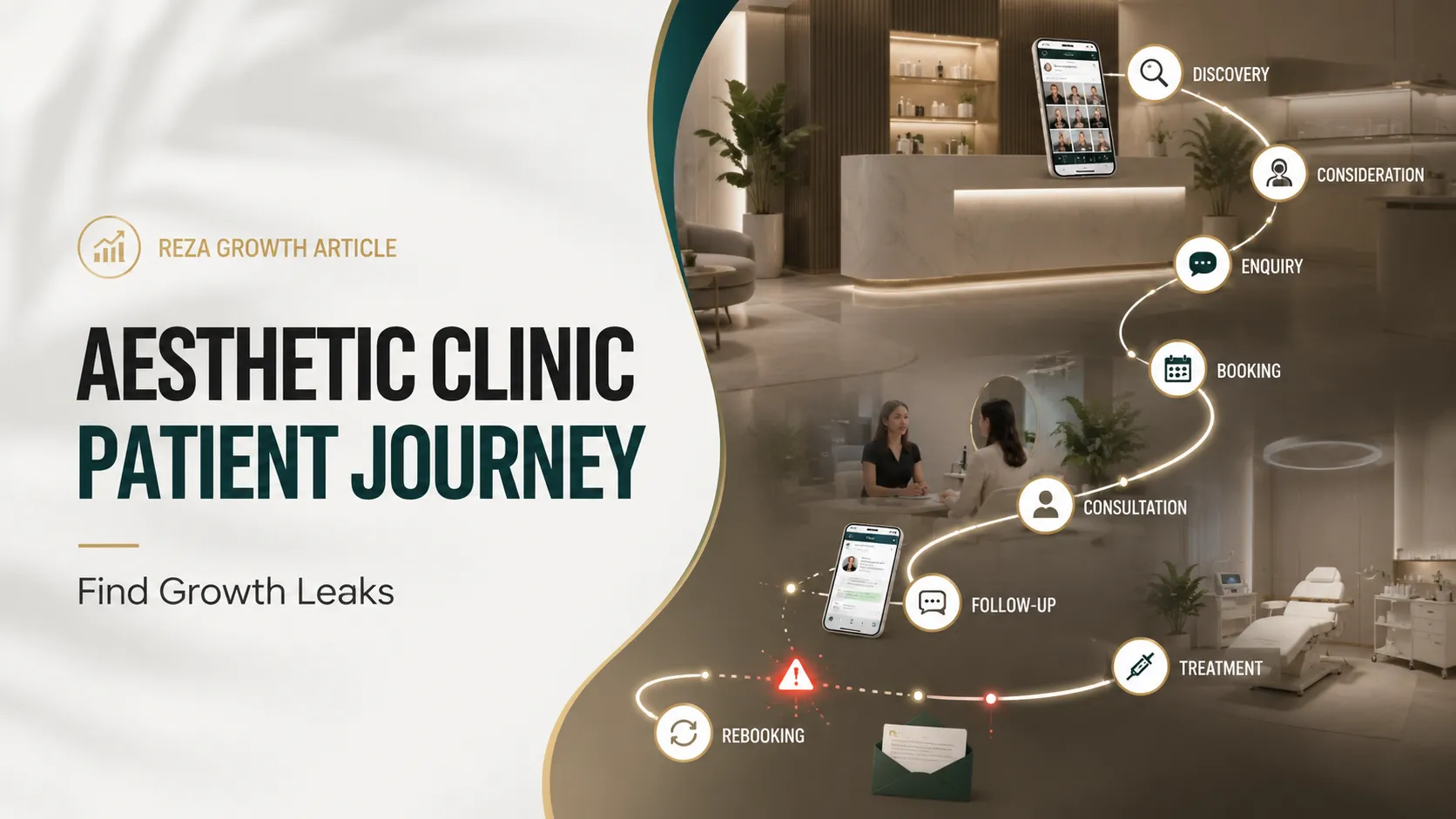
The aesthetic clinic patient journey is every step a patient moves through from first discovering your clinic to making an enquiry, booking, having treatment and deciding whether to return.
For clinic owners, mapping this journey is useful for a different reason: it shows where patient growth is being lost. A clinic may have strong traffic but too few enquiries, plenty of enquiries but weak booking rates, or satisfied patients who are rarely encouraged to return.
What Is the Aesthetic Clinic Patient Journey?
The patient journey is the sequence of interactions a person has with your clinic before, during and after becoming a patient.
It may begin with a Google search, an Instagram Reel, a recommendation or a treatment page. It continues through research, comparison, enquiry and booking, but it should not end once treatment has been delivered.
For an aesthetic clinic, a practical journey can be mapped as:
-
Discovery
The potential patient first becomes aware of the clinic or treatment. -
Consideration
They research the clinic, practitioner, treatment and alternatives. -
Enquiry
They make contact through a form, direct message, WhatsApp or phone call. -
Booking
They decide whether to take the next step and schedule a consultation or appointment. -
Consultation
They receive the information needed to decide whether treatment is appropriate for them. -
Treatment
The actual patient experience shapes satisfaction, trust and future decisions. -
Follow-Up
The clinic continues the relationship after the appointment. -
Rebooking
An appropriate patient has a clear path back to the clinic when another visit makes sense.
The important point is that these stages are connected. Improving one part of the journey while ignoring the others can simply move the bottleneck somewhere else.
Why the Patient Journey Matters for Clinic Growth
When bookings are below target, the immediate reaction is often to generate more leads. But more enquiries do not automatically solve a weak patient journey.
Imagine a clinic receives 100 enquiries in a month. If a large percentage wait too long for a response, receive unclear information or never hear from the clinic again after their first conversation, increasing the number of enquiries may simply increase the number of opportunities being lost.
Instead of asking only, “How do we get more patients?”, ask, “At what stage are potential patients currently dropping out?”
This is also why a useful aesthetic clinic marketing plan should connect acquisition activity to what happens after somebody clicks, enquires or books.
Stage 1: Discovery — How Patients First Find Your Clinic
Discovery is the first meaningful contact between a potential patient and your clinic.
Depending on your market, that first touchpoint might be:
- A Google search for a treatment or local provider
- An Instagram Reel, Story or profile visit
- A recommendation from an existing patient
- A paid advertisement
- A local search or map result
- A mention from another business or practitioner
What the patient needs at this stage
Someone at the discovery stage does not necessarily need every detail about your clinic. They need enough relevance to decide whether you deserve further attention.
Your message should make it reasonably clear what you offer, who it is for and why somebody should investigate your clinic instead of immediately moving to another option.
Common growth leaks at the discovery stage
- Your clinic appears for the wrong searches or reaches the wrong audience.
- Social content receives attention but creates little interest in the clinic itself.
- The clinic looks similar to every nearby competitor.
- The message focuses on treatments but gives patients no clear reason to choose the clinic.
This is why positioning should come before simply increasing content volume. A clear aesthetic marketing strategy should identify what the clinic needs to communicate before deciding how aggressively to distribute that message.
Stage 2: Consideration — Why Patients Compare Before They Enquire
A potential patient who discovers your clinic will often investigate further before contacting you.
They may visit your website, read treatment pages, check reviews, look at practitioner information, browse social media, study before-and-after examples and compare your clinic with alternatives.
What the patient needs at this stage
The primary need is confidence. The patient is trying to reduce uncertainty before making contact.
Useful consideration-stage information may include:
- Clear information about the relevant treatment
- Practitioner credentials and clinic information
- Realistic information about the process and what to expect
- Reviews and appropriate patient experiences
- Before-and-after examples where suitable and compliant
- Answers to common questions and concerns
- A simple explanation of the next step
Common consideration-stage leaks
A clinic can generate awareness successfully and still lose potential patients here.
For example, an Instagram post may create interest in a treatment, but the visitor reaches a thin treatment page with little useful information. Another clinic provides clearer practitioner information, more reassurance and a simpler route to consultation, so the patient continues there instead.
Your website is particularly important at this stage. The right aesthetic clinic website should support patient decision-making rather than acting as a digital brochure.
Stage 3: Enquiry — Turning Interest Into a Real Conversation
An enquiry is one of the most important transitions in the patient journey because the potential patient has moved from passive research to active interest.
Enquiries can arrive through several channels:
- Website forms
- Instagram or Facebook messages
- Phone calls
- Online booking systems
What the patient needs at this stage
They need a response that is timely, clear and useful. They should understand what happens next without having to repeatedly chase the clinic for basic information.
The team answering enquiries should also know how to distinguish between providing helpful administrative information and making decisions that belong with an appropriately qualified practitioner.
Where aesthetic clinics lose enquiries
A potential patient sends an Instagram message asking about a treatment on Monday afternoon. The clinic responds on Tuesday with only a price. The patient asks one follow-up question, receives no reply until Wednesday and eventually books with another provider.
The problem was not lead generation. The clinic already had the opportunity. The leak happened inside the enquiry process.
Common problems include slow responses, inconsistent answers between team members, no defined ownership of incoming enquiries and conversations that end without a clear next step.
Stage 4: Booking — Making the Next Step Easy
Interest does not become revenue simply because somebody contacted the clinic. The route from enquiry to booking still needs to work.
A useful booking process removes unnecessary friction while keeping any appropriate clinical and administrative requirements intact.
Review questions such as:
- Can the team quickly explain the available next step?
- Does the patient know whether they need a consultation first?
- Is appointment availability communicated clearly?
- Is the deposit or booking policy explained before it creates confusion?
- Can the patient easily complete the required booking action?
- Is there a process for enquiries that do not book immediately?
A patient may be ready to proceed but still drop out because the booking process requires too many messages, unclear instructions or unnecessary waiting.
Stage 5: Consultation — Helping the Patient Make a Confident Decision
The consultation is not simply another sales stage. In aesthetics, it is an important point where the patient can receive appropriate information, discuss expectations and understand whether a proposed treatment is suitable.
From a patient-journey perspective, the clinic should focus on consistency between what was communicated before the appointment and what the patient experiences during the consultation.
If marketing creates unrealistic expectations that the consultation later needs to correct, the journey is already misaligned.
Marketing, reception and practitioners therefore should not operate as completely separate parts of the business. The patient experiences one clinic, not three departments.
Stage 6: Treatment — The Experience That Shapes Retention
The treatment stage is where the promises made earlier in the patient journey meet the actual clinic experience.
Not every part of this stage is a marketing responsibility, but it has a major effect on future growth. Communication, organisation, professionalism and the overall experience can influence whether a patient returns, recommends the clinic or leaves a positive review.
This means acquisition and retention are connected. A clinic can spend heavily acquiring new patients while losing much of the long-term value of that investment after the first appointment.
Stage 7: Follow-Up — What Happens After the Appointment Matters
Once the patient leaves the clinic, the relationship should not simply disappear from the system.
Appropriate post-appointment communication will depend on the treatment, clinic process and applicable professional requirements. From a growth-system perspective, however, the important point is that the clinic knows what should happen next and who is responsible for it.
A structured system can distinguish between different purposes:
- Administrative or appropriate post-appointment communication
- Requesting feedback at an appropriate point
- Reminding eligible patients when another visit may be relevant
- Reactivating patients who have not returned for a longer period
The objective is not to send constant promotional messages. It is to prevent valuable patient relationships from becoming invisible simply because there is no process for the next stage.
Stage 8: Rebooking and Retention — The Journey Does Not End After Treatment
Many clinics concentrate heavily on finding new patients while previous patients receive little structured communication.
For appropriate treatments and patients, retention can include planned reminders, rebooking processes, reactivation campaigns and relevant complementary services.
The exact approach should depend on the clinic’s services and patient needs rather than applying the same schedule to everyone.
Build a clearer path for existing patients to return
Reza Growth’s aesthetic clinic patient retention system is designed for clinics that already have previous patients but lack a structured process for reminders, rebooking and reactivation.
How to Map Your Current Aesthetic Clinic Patient Journey
You do not need complicated software to create the first version of your patient journey map. Start by documenting what actually happens now rather than what is supposed to happen.
-
List every major stage
Start with discovery and continue through consideration, enquiry, booking, consultation, treatment, follow-up and rebooking. -
Identify the touchpoints
Write down where each stage happens: Google, Instagram, website pages, forms, WhatsApp, phone, reception desk, CRM or another system. -
Write down what the patient needs
Consider the question or uncertainty the patient is trying to resolve at that particular stage. -
Document the clinic action
Record what your team currently does in response and who owns that action. -
Identify the possible leak
Look for unclear messaging, delays, missing information, difficult booking steps or absent follow-up. -
Attach a useful metric
Where possible, measure whether patients are moving successfully to the next stage.
| Journey Stage | Patient Need | Clinic Action | Possible Leak | Useful Metric |
|---|---|---|---|---|
| Discovery | Find a relevant clinic | Create visibility with a clear message | Wrong audience or weak differentiation | Qualified traffic or profile visits |
| Consideration | Build confidence | Provide useful decision-making information | Weak trust signals or unclear treatment information | Enquiry rate |
| Enquiry | Get answers and understand the next step | Respond clearly and consistently | Slow or incomplete responses | Response and progression rate |
| Booking | Take the next step easily | Provide a clear booking route | Friction or missing follow-up | Enquiry-to-booking rate |
| Retention | Know when another visit is relevant | Use an appropriate rebooking or reactivation process | No structured post-treatment communication | Repeat visit rate |
How to Find the Biggest Leaks in the Patient Journey
Once the journey is mapped, avoid trying to improve everything at once. Find the stage where the largest meaningful drop-off occurs.
Traffic but few enquiries
Investigate the consideration stage. Visitors may not be finding enough relevance, trust or clarity to contact the clinic.
Enquiries but few bookings
Investigate response times, conversation quality, booking friction, objection handling and follow-up.
Bookings but frequent drop-off
Review reminders, pre-appointment communication, booking expectations and other operational friction before the appointment.
Patients but little repeat business
Review what happens after treatment and whether appropriate patients have a structured route to rebooking.
This approach helps distinguish a traffic problem from a conversion problem or a retention problem. Without that distinction, clinics can invest in the wrong solution.
Track the Journey as a System, Not Separate Marketing Activities
A common mistake is measuring each marketing channel independently without checking whether patients actually continue through the full journey.
Instagram may generate enquiries. SEO may bring search traffic. A website may collect consultation requests. Reception may handle bookings. A CRM may manage patient records.
But from the patient’s perspective, these are not separate systems.
They are one journey.
Your reporting should therefore help answer questions such as:
- Which sources are producing meaningful enquiries?
- What percentage of enquiries receive a response?
- What percentage progress to a consultation or booking?
- Where are potential patients most commonly dropping out?
- How many appropriate previous patients return?
A useful patient journey has five characteristics
- Every important stage has a clear purpose.
- The patient knows what the next step is.
- The clinic knows who owns each touchpoint.
- Important drop-offs can be measured.
- The journey continues beyond the first booking.
A Simple Aesthetic Clinic Patient Journey Framework
If you want to review your clinic without overcomplicating the exercise, start with this sequence:
Discovery → Consideration → Enquiry → Booking → Consultation → Treatment → Follow-Up → Rebooking
Then work through the journey from left to right.
At every stage, ask:
- What does the patient need here?
- What are we currently doing to meet that need?
- What should happen next?
- Where could the patient drop out?
- Can we measure whether they progressed?
The goal is not to create the longest possible journey map. It is to make the critical transitions visible.
Once those transitions are visible, growth decisions become more specific. You can identify whether the next priority should be stronger positioning, better website content, improved enquiry handling, an easier booking process or a more structured retention system.
Find where patient growth is getting lost
Reza Growth reviews the connected path from positioning and acquisition through conversion and retention, helping aesthetic clinics identify where their current growth system needs attention.